Quiz -Section 3 Terms, Definitions, Acronyms, and Abbreviations – CWI Part C -7 Questions

Read Carefully and Take a Test
Section 3: Terms, Definitions, Acronyms, and Abbreviations
For the purposes of this standard, the welding terms and definitions in AWS A3.0 Standard Welding Terms and Definitions apply with the additions and modifications listed in subsection 3.1.
Terms defined in AWS A3.0 are not defined again here. Additional key terms not defined in Section 3 of the standard or
AWS A3.0 is defined below:
Butt Weld. A nonstandard term for a groove weld in a butt joint.
Classification (AWS). The AWS designation lists rods, electrodes, and filler metals according to their chemical composition and operating characteristics. Examples include, for SMAW—E7018, for GMAW—ER70S-6, and for GTAW— with-2.
Coupon test report. A form that can be used to record either procedure qualification or welder qualification test results or report on a weld coupon from a production weld. It is sometimes referred to as a “weld test report.”
Crown surface. A nonstandard term for weld face, usually referring to the final bead placed on the outside of a pipe.
Destructive testing. Mechanical testing destroys a sample or part in the process of measuring a specific material property.
Essential variable. A variable that has a significant effect on mechanical properties for procedure qualification or welder/operator skill for performance qualification. In general, if the value for an essential variable is changed to a value outside the range qualified, as defined by the code or standard in question, requalification of the procedure or welder/operator by testing is required. The essential variables for procedure and performance qualification are not the same within any given code or standard. Similarly, the essential variables for procedure or performance qualification are not usually the same from one code or standard to the next.
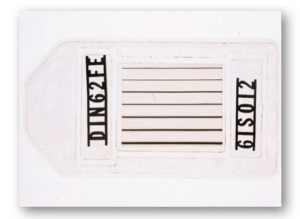
Image quality indicator (IQI). A device used to confirm the resolution sensitivity of radiographic images. This is sometimes referred to as penetrometers or “penny.” See Study Guide Figure 3.1 below.
Lineup clamp. An external or internal device used to bring two pipe segments into alignment for pre-weld tacking or for welding.
Nick break test. A destructive test used to determine the soundness of weld metal by fracturing the specimen through the weld so the fractured surface of the weld metal can be visually examined for the presence of discontinuities.
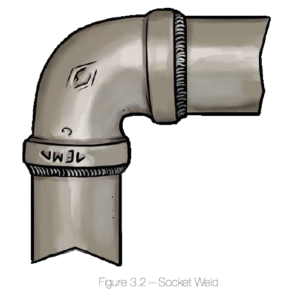
Pipe nipple. A short length or section of a pipe, usually used for qualifying a procedure or a welder. shielding atmosphere. A gas envelope surrounding the weld area during welding to prevent or reduce the formation of oxides or other detrimental surface substances and facilitate their removal. socket weld. A fillet weld joins two pipes or a pipe to a pipe fitting, where one pipe is inserted into the other pipe or into the fitting. See Study Guide Figure 3.2 below.
Shielding atmosphere. A gas envelope surrounding the weld area during welding to prevent or reduce the formation of oxides or other detrimental surface substances and facilitate their removal.
Socket weld. A fillet weld joins two pipes or a pipe to a pipe fitting, where one pipe is inserted into the other pipe or into the fitting. See Study Guide Figure 3.2 below.
Soundness. Relative freedom from imperfections.
Soundness testing. Testing is done to verify that a weldment is free from defects. API 1104 permits the use of bend and nick break destructive tests, as well as radiographic and ultrasonic testing, which are both nondestructive tests.
Specifications (AWS). An AWS document that lists the rods, electrodes, or filler metals that can be used to weld a given category of base metals with a given category of welding processes. An example is AWS A5.1, Specification for Carbon Steel Electrodes for Shielded Metal Arc Welding.
Specified minimum tensile strength (SMTS). The minimum ultimate tensile strength, specified by the pipe specification, for any given grade of pipe. For instance, the API 5L Grade X52 pipe has an SMTS of 66,000 psi, meaning that a tension test of this pipe will result in an ultimate tensile strength of no less than 66,000 psi.
Specified minimum yield strength (SMYS). The minimum yield strength, specified by the pipe specification, for any given grade of pipe. For instance, the API 5L Grade X52 pipe has an SMYS of 52,000 psi, meaning that a tension test of this pipe will result in a yield strength no less than 52,000 psi.
Speed of travel. The rate of welding progression along the weld joint.
Tensile strength test. A test in which the specimen is loaded in tension until failure occurs. This is also referred to as a tension test.
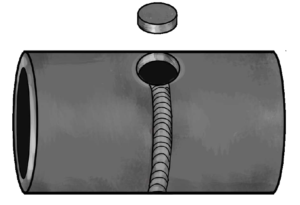
Trepanning. A process, typically using a hole saw, in which a disc-shaped specimen containing a section of the weld is removed from a pipe weld. The disc is removed so the inspector can evaluate the weld quality and/or the degree of penetration. Trepanning is generally not permitted for production piping applications. See Study Guide Figure 3.3 below.
Yield strength. The point at which a metal’s response to the application of tensile load changes from elastic to plastic.
In some cases, API 1104 uses different terms to refer to the same feature or characteristic. For instance, the terms “discontinuity,” “imperfection,” “few,” “irregularity,” and “anomaly” are used interchangeably in the text. However, only “imperfection” is defined in paragraph 3.1 .1 1.
All of these terms, however, have the same meaning. Similarly, the terms “position welding and “fixed” welding are used interchangeably, although only “position welding” is defined in paragraph 3.1.17. In addition, the term “porosity” is defined in AWS A3.0 and is used in API 1104, but the term “voids” is used as well; “voids” is not defined in API 1104 but has the same meaning as “porosity.” Root face is a standard term defined in AWS A3.0, but API 1104 also uses the nonstandard term “land” to refer to the root face of a
weld joint.
Section 3 Terms, Definitions, Acronyms, and Abbreviations – CWI Part C Practice Test
Prepare for the AWS CWI Part C Open Book Exam with this free practice test based on API 1104 Section 3: Terms, Definitions, Acronyms, and Abbreviations. This section is very important because it explains the key technical terms, definitions, acronyms, and abbreviations used throughout API 1104.
In this quiz, you can take a free practice test with the latest exam-style questions and answers for CWI Part C API 1104 Section 3.
Take Free CWI Part C API 1104 Practice Test
This free quiz is designed for students, welding inspectors, QA/QC professionals, and candidates preparing for the AWS CWI Part C exam using API 1104.
Section 3 helps candidates understand the meaning of important words and abbreviations used in the code. A clear understanding of these terms is necessary for correctly interpreting the requirements of API 1104 during the open book exam.
Quiz Details
Quiz Name: Section 3 Terms, Definitions, Acronyms, and Abbreviations – CWI Part C
Standard Covered: API 1104
Exam Type: AWS CWI Part C Practice Test
Total Questions: 7 Questions
Question Type: Multiple Choice Questions
Level: Beginner to Exam Preparation Level
Buy the Latest AWS CWI Exam Self-Study Material Question Bank
FOR EVERY 10 QUESTIONS, 1 QUESTION COMES INTO THE EXAM IN
Part A
Part B
Part C
Cost: $100
Email Us To Buy: upweld.org@gmail.com
Contact on WhatsApp https://wa.link/j7oewk
We give you lots of study material, Free of cost, with this question bank.
What Is Covered in API 1104 Section 3?
API 1104 Section 3 provides the terms, definitions, acronyms, and abbreviations used in the standard. These definitions help candidates understand the exact meaning of words used in welding procedure qualification, welder qualification, production welding, inspection, examination, and acceptance criteria.
In code exams, small differences in terminology can change the meaning of a requirement. That is why Section 3 is useful for improving code interpretation skills.
What You Will Learn in This Quiz
This practice test will help you understand:
- Important terms used in API 1104
- Definitions related to welding, inspection, and examination
- Common acronyms and abbreviations used in the standard
- How Section 3 supports the correct interpretation of other API 1104 sections
- Why are definitions important in the AWS CWI Part C open-book exam
- How to quickly identify the meaning of technical terms during exam preparation
Why Practice Section 3 Terms and Definitions?
Many candidates focus only on acceptance criteria and welding requirements, but terms and definitions are also important for the CWI Part C exam. If you do not understand the meaning of a term, it becomes difficult to answer code-based questions correctly.
This section helps you build a strong foundation before studying more detailed API 1104 sections. It also improves your speed when searching and interpreting the code during the open-book exam.
Importance of Acronyms and Abbreviations in API 1104
API 1104 uses many technical acronyms and abbreviations related to welding processes, inspection methods, testing, and qualification. Knowing these short forms helps candidates read the code faster and understand exam questions more clearly.
For CWI Part C candidates, memorizing and understanding common acronyms and abbreviations can save valuable time during the exam.
Start the Free Practice Test
Click below to take the free quiz:
Quiz – Section 3 Terms, Definitions, Acronyms, and Abbreviations – CWI Part C – 7 Questions
https://upweld.org/section-3-terms-definitions-acronyms-and-abbreviations/
Who Should Take This Practice Test?
This quiz is useful for:
- AWS CWI exam candidates
- CWI Part C API 1104 students
- Welding inspectors
- QA/QC inspectors
- Pipeline welding professionals
- Welding engineers
- NDT technicians
- Students preparing for open-book code exams
- Candidates who want to improve API 1104 code navigation skills
Prepare Better for AWS CWI Part C
If you are preparing for the AWS CWI Part C exam, section-wise practice is one of the best ways to improve your understanding of API 1104. Start with Section 3, Terms, Definitions, Acronyms, and Abbreviations, and continue practicing other sections to build confidence for the exam.
Take the free practice test now and improve your preparation for the AWS CWI Part C API 1104 exam.