Latest API 510 & API 570 Interview Questions and Answers for Pressure Vessel and Piping Inspectors Preparation
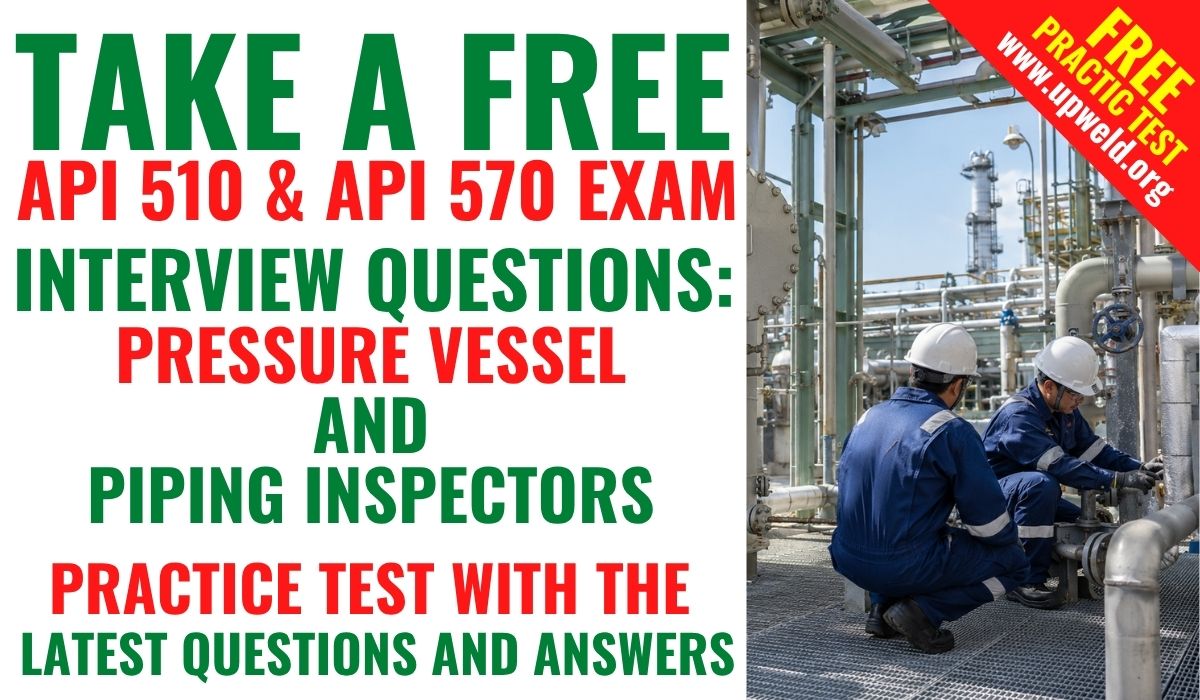
Prepare with the latest API 510 and API 570 interview questions and answers for pressure vessel and piping inspectors. Covers MAWP, hydrotest, NDE, PMI, corrosion, damage mechanisms, ASME Section VIII, ASME B31.3, and real inspection scenarios.
Are you preparing for an API 510 or API 570 inspector interview? If yes, you already know that interviewers do not ask only simple definition-based questions. They test your real inspection knowledge, your understanding of pressure equipment integrity, your ability to identify damage mechanisms, and your practical decision-making during shutdowns, repairs, hydrotests, and fitness-for-service evaluations.
This page provides the latest API 510 and API 570 interview questions and answers for pressure vessel inspectors, piping inspectors, inspection engineers, QA/QC inspectors, mechanical integrity professionals, refinery inspectors, and plant inspection personnel.
These questions cover practical topics such as MAWP, design pressure, hydrostatic testing, ASME Section VIII, ASME B31.3, API 571 damage mechanisms, API 578 PMI, NDE methods, corrosion under insulation, chloride stress corrosion cracking, HTHA, amine SCC, sour service damage, PWHT, piping dead legs, branch connections, temporary repairs, and real field inspection scenarios.
If you want to perform well in an API 510 or API 570 interview, you must understand not only the correct answer but also the reason behind it. That is why each question on this page includes answers and explanations to help you build practical inspection confidence.
What Are API 510 and API 570?
API 510 is the inspection code used for in-service inspection, repair, alteration, and rerating of pressure vessels. It is highly important for inspectors working with refinery vessels, columns, drums, separators, heat exchangers, and other pressure-retaining equipment.
API 570 is the inspection code used for in-service inspection, repair, alteration, and rerating of piping systems. It is commonly used in refineries, petrochemical plants, oil and gas facilities, chemical plants, power plants, and process industries.
Both certifications are highly valuable for professionals who want to grow in inspection, mechanical integrity, asset integrity, shutdown inspection, plant maintenance, and QA/QC roles.
Why API 510 & API 570 Interview Questions Are Important
API inspection interviews are usually practical. A hiring manager may not simply ask, “What is MAWP?” Instead, they may ask what you would do if corrosion reduces the MAWP of a vessel. They may ask how you would inspect a dead leg in piping, how you would handle wrong material installation, or how you would evaluate a temporary clamp on a leaking branch connection.
This means your preparation must include:
-
Code-based knowledge
-
Damage mechanism understanding
-
Practical inspection judgment
-
NDE method selection
-
Repair and alteration awareness
-
Hydrotest and pressure test understanding
-
PMI and material verification knowledge
-
Scenario-based decision-making
A good API inspector must be able to connect field findings with code requirements, engineering evaluation, risk, and safe operation.
Important API 510 Interview Topics
If you are preparing for an API 510 pressure vessel inspector interview, focus on the following topics:
-
Pressure vessel inspection intervals
-
Internal and external inspection requirements
-
MAWP and design pressure
-
Corrosion rate and remaining life
-
Minimum required thickness
-
Hydrostatic and pneumatic testing
-
Pressure relief device review
-
Repairs, alterations, and rerating
-
ASME Section VIII basics
-
PWHT requirements
-
Weld joint efficiency
-
Brittle fracture
-
Fitness-for-Service assessment
-
API 571 damage mechanisms
-
API 578 PMI requirements
-
Nameplate and documentation verification
A strong API 510 candidate should be able to explain how vessel condition affects safe operation and what actions are needed when corrosion, cracking, wrong material, or repair concerns are found.
Important API 570 Interview Topics
For API 570 piping inspector interviews, focus on:
-
Piping inspection intervals
-
Thickness monitoring locations
-
Corrosion rate calculation
-
Remaining life calculation
-
Dead legs and injection points
-
Soil-to-air interfaces
-
CUI in piping systems
-
Temporary repairs and clamps
-
ASME B31.3 pressure testing
-
Category D and Category M fluid service
-
Piping flexibility and expansion loops
-
Branch connection inspection
-
Piping supports and corrosion at supports
-
Leak management
-
Repair documentation
-
PMI in alloy piping systems
A strong API 570 candidate must understand piping circuits, corrosion loops, material verification, pressure testing, and practical inspection planning.
API 510 and API 570 Damage Mechanisms You Must Know
Damage mechanism questions are very common in API inspector interviews. Interviewers may ask direct questions or give a field scenario and expect you to identify the likely damage mechanism.
Important damage mechanisms include:
-
Sulfide Stress Cracking
-
High-Temperature Hydrogen Attack
-
Chloride Stress Corrosion Cracking
-
Amine Stress Corrosion Cracking
-
Corrosion Under Insulation
-
Microbiologically Influenced Corrosion
-
Erosion-corrosion
-
Flow-Accelerated Corrosion
-
Caustic cracking
-
Carburization
-
Sour water corrosion
-
Hydrogen-Induced Cracking
-
Stress-Oriented Hydrogen-Induced Cracking
-
Brittle fracture
-
Thermal fatigue
-
Creep damage
To answer these questions correctly, do not memorize only the name of the mechanism. Understand the material, environment, temperature, stress condition, appearance, and inspection method.
API 510 & API 570 Interview Preparation Tips
1. Understand the difference between code knowledge and field judgment: In an interview, knowing the code is important, but field judgment is what makes your answer strong. For example, if corrosion is found, do not simply say “calculate remaining life.” A better answer includes thickness verification, corrosion rate review, damage mechanism identification, inspection extent, engineering evaluation, and documentation.
2. Learn MAWP, design pressure, and test pressure clearly: Many candidates confuse MAWP, design pressure, operating pressure, and hydrotest pressure. These are basic but critical topics. Be ready to explain them with examples.
3. Study API 571 damage mechanisms: API 571-based questions are common because real inspection work is damage-mechanism driven. Learn where each damage mechanism occurs and which NDE method is suitable.
4. Understand API 578 PMI requirements: Material mix-ups are a serious inspection concern. Be ready to explain XRF, OES, alloy verification, carbon detection limitations, and when PMI is critical.
5. Practice scenario-based questions: Scenario questions test your practical thinking. Examples include wrong material installation, corrosion at supports, temporary clamps, hydrotest boundary errors, amine cracking, HTHA, and CUI.
6. Do not give unsafe answers: In API inspection interviews, avoid answers like “accept it if it looks okay” or “continue operation without documentation.” Always mention evaluation, code compliance, engineering approval, inspection records, and risk-based decision-making.
Common API 510 & API 570 Interview Mistakes
Many candidates fail API inspection interviews because they give short textbook answers without showing practical understanding. Avoid these mistakes:
-
Confusing MAWP with design pressure
-
Ignoring relief valve set pressure
-
Treating temporary repairs as permanent repairs
-
Not considering damage mechanisms
-
Selecting the wrong NDE method
-
Ignoring PMI requirements
-
Not mentioning MOC for process or material changes
-
Re-insulating corroded areas without full inspection
-
Ignoring similar-service inspection expansion
-
Not documenting repair and rerating decisions
-
Assuming stainless steel is always corrosion-resistant
-
Missing CUI and dead leg risks
A good inspector thinks beyond the visible defect. They ask: What caused it? Where else can it exist? Is the equipment still safe? What code or engineering evaluation is needed? What documentation must be updated?
Who Should Use These API 510 & API 570 Interview Questions?
These questions are useful for:
-
API 510 pressure vessel inspector candidates
-
API 570 piping inspector candidates
-
QA/QC inspectors
-
Welding inspectors
-
Mechanical inspectors
-
Inspection engineers
-
Asset integrity engineers
-
Shutdown inspectors
-
Refinery inspection personnel
-
Petrochemical plant inspectors
-
Oil and gas maintenance professionals
-
NDE technicians moving into inspection roles
-
Freshers preparing for inspection interviews
Whether you are preparing for a job interview, technical discussion, shutdown role, refinery inspection position, or API certification pathway, these questions can help you understand the practical expectations of the inspection industry.
Final Words: API 510 and API 570 interviews are not only about remembering definitions. They are about proving that you can protect pressure equipment integrity, understand inspection codes, identify damage mechanisms, select suitable NDE methods, evaluate risk, and make safe recommendations.
Use these latest API 510 and API 570 interview questions and answers to prepare for technical interviews and strengthen your real-world inspection knowledge.
If you are serious about becoming a better pressure vessel or piping inspector, keep practicing scenario-based questions. The more real field situations you understand, the stronger your inspection judgment becomes.
Prepare smarter with UpWeld.
Explore more free inspection, welding, NDE, QA/QC, API, ASME, and plant inspection learning resources at:
Here you can take a free API 510 EXAM Practice Test Quiz Course
Here you can take a free API 570 EXAM Practice Test Quiz Course
For study material, exam preparation support, and the latest question banks, contact:
Buy Latest API 510 and API 570 Exam Study Material Question Bank
IN EVERY 10 QUESTIONS, 1 QUESTION COMES ON THE EXAM
WE HAVE THE LATEST API 510 and API 570 EXAM QUESTION BANK
Total 5000+ Questions in the QUESTION BANK
Each Cost: $100 USD
Email Us To Buy: upweld.org@gmail.com
Contact on WhatsApp https://wa.link/j7oewk
Ideally, a document for passing the examination. Free guidelines during learning.
We give you lots of study material, free of cost, with this question bank.